Differences Between Regional Radio Frequencies and Internet Live Radio
Advances in audio technology have provided listeners with two primary delivery methods for radio broadcasting: traditional regional radio frequencies (AM/FM Terrestrial Radio) and internet live radio (Internet Live Radio / IP Streaming). Although both deliver audio content, these two technologies operate on fundamentally different infrastructure. Understanding the key distinctions between them helps you choose the optimal solution for music, news, or real-time event updates.
Overview of Regional Radio Frequencies vs. Internet Live Radio
Regional radio frequencies rely on ground-based transmitters to broadcast electromagnetic signals across AM (Amplitude Modulation) or FM (Frequency Modulation) spectrums. These signals travel through the air and are picked up directly by receiver antennas within a defined geographic radius.
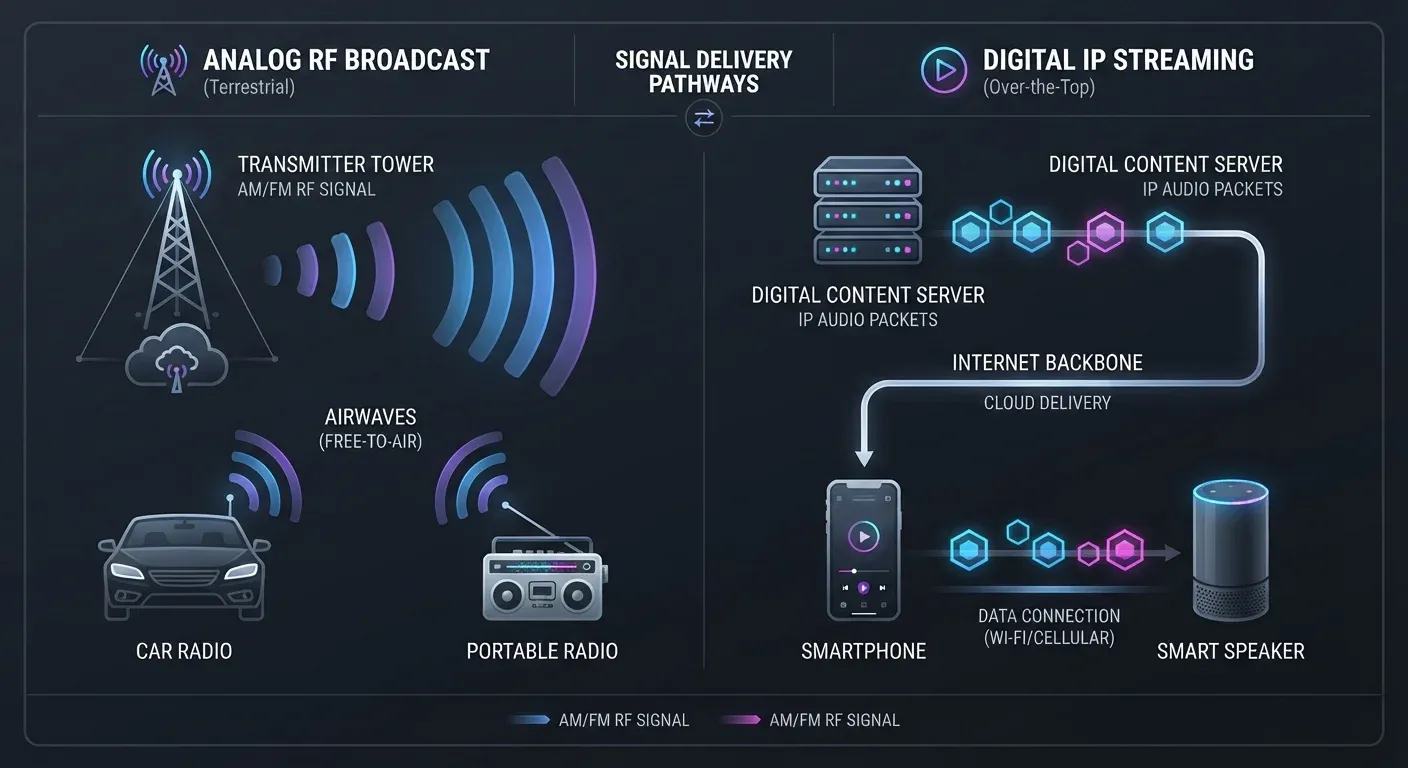
By contrast, internet live radio compresses digital audio into data packets transmitted over IP networks. Listeners access this audio stream via Wi-Fi, 4G/5G, or wired connections on smartphones, computers, or smart speakers, completely independent of the station's physical location.
Detailed Comparison: Terrestrial RF vs. Internet Radio (IP Streaming)
Bandwidth and Geographic Coverage Radius
Terrestrial radio coverage is bounded by transmitter wattage, tower height, and local topography.
- AM Waves: Capable of long-distance propagation via ionospheric reflection, but highly susceptible to weather interference and structural obstacles.
- FM Waves: Provide superior signal stability, but coverage radii typically max out between 50 km and 100 km around the transmitter. Beyond this perimeter, the signal degrades into static noise.
Internet radio eliminates geographic borders entirely. You can tune into a local station based in New York, London, or Tokyo while sitting anywhere in the world, provided you have a stable internet connection.
Audio Quality and Fidelity
Audio fidelity between the two technologies depends on encoding methods and physical bandwidth limits.
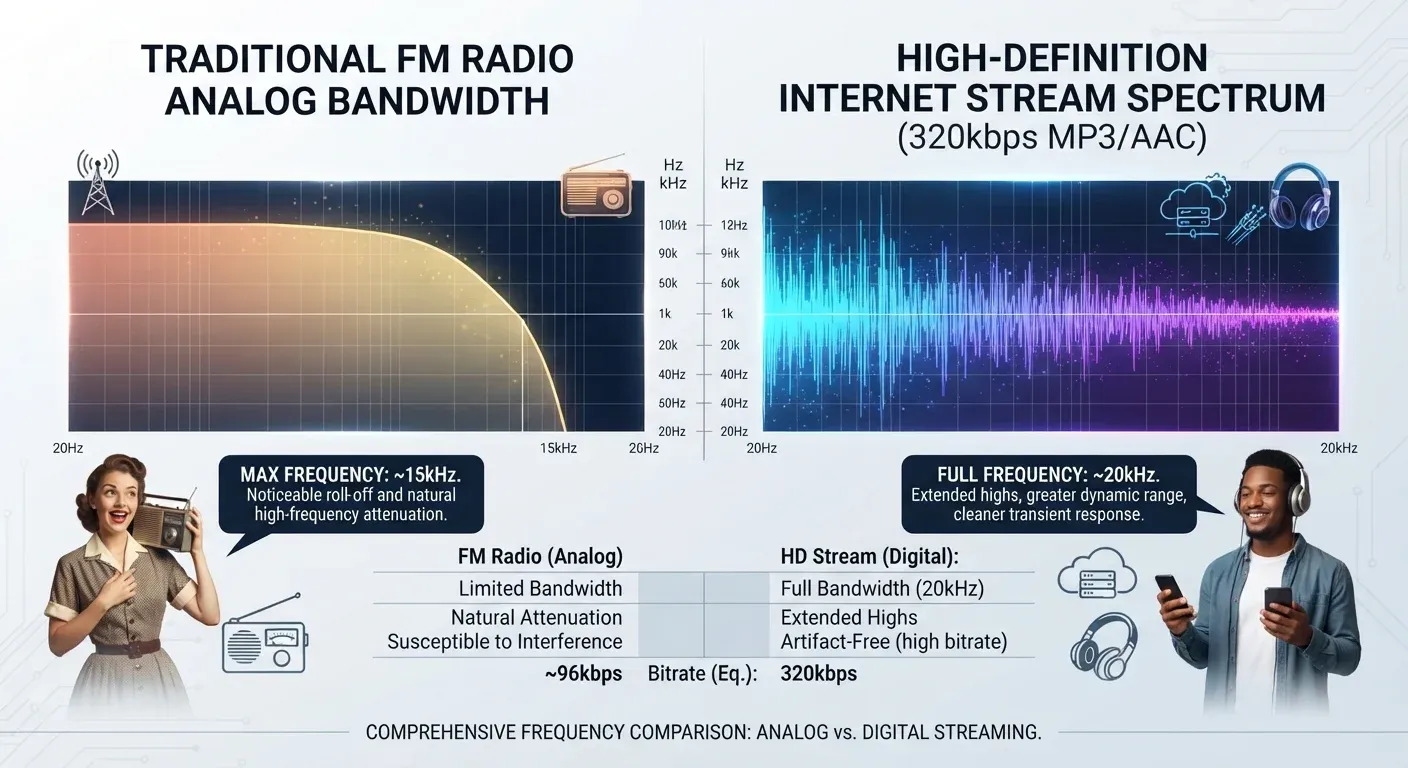
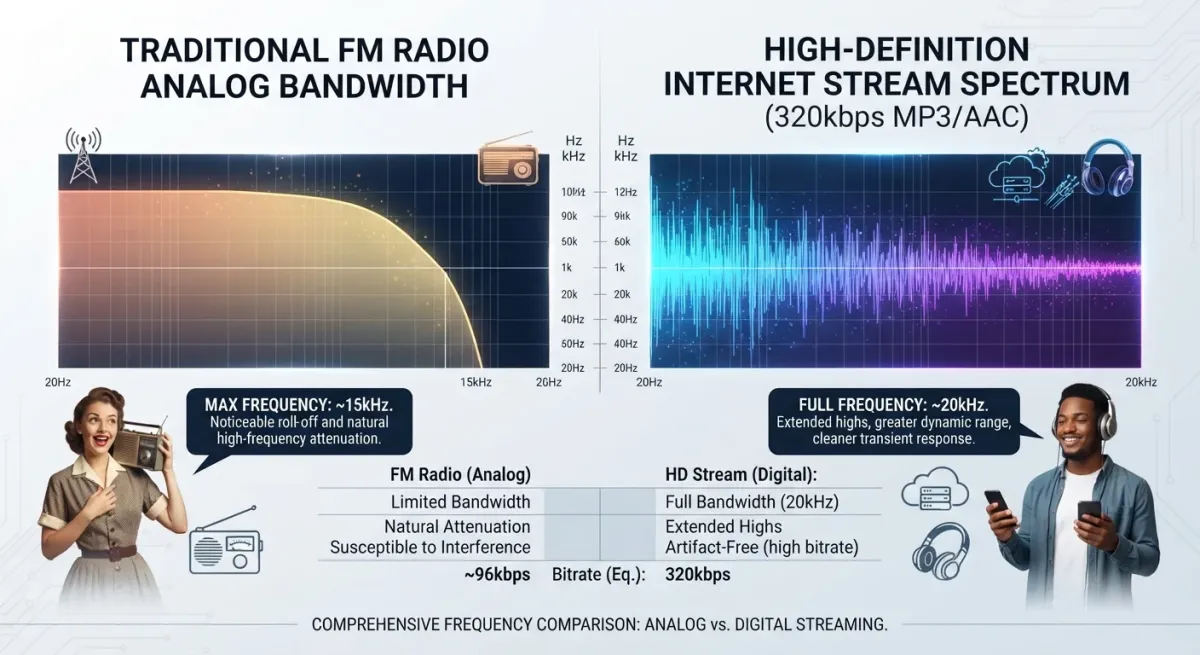
- AM Waves: Capped at an audio bandwidth around 5 kHz, making it best suited for talk radio, news, and sports commentary.
- FM Waves: Provide a broader spectrum up to 15 kHz, delivering standard high-fidelity audio suitable for general music broadcasting.
- Internet Radio: Utilizes advanced audio codecs like MP3, AAC, or FLAC with bitrates ranging from 128 kbps to 320 kpbs or higher. At 320 kpbs, audio fidelity approaches CD quality, offering richer dynamic range and deeper bass than FM radio.
Latency and Real-Time Synchronization
Signal delay is a crucial technical difference between analog radio broadcasts and internet streams.
- Terrestrial RF: Signals travel at the speed of light directly from the transmitter to the receiver antenna. Latency is virtually 0, offering true real-time delivery. This is vital when following live sports commentary, call-in interactive shows, or emergency broadcast warnings.
- Internet Radio: Audio undergoes digital encoding, packetization, server routing, and client-side buffering. This pipeline generates a delay ranging from 15 seconds to over 1 minute.
Mobile Data, Equipment Costs, and Infrastructure Resilience
- Terrestrial RF: Free to receive with zero data costs or subscription fees. It requires only a standard tuner (built into most vehicles and portable devices). Terrestrial networks remain operational during power grid failures or internet outages.
- Internet Radio: Demands smart hardware and continuous internet connectivity. On 4G/5G mobile networks, data usage averages:
- Stream at 128 kbps: Consumes ~ 57 MB/hour.
- Stream at 320 kbps: Consumes ~ 144 MB/hour.
Localized Content vs. Global Variety
- Terrestrial RF: Deeply anchored in local communities. It serves as the primary source for real-time traffic alerts, regional weather forecasts, local news, and urgent emergency notifications.
- Internet Radio: Unlocks access to tens of thousands of global stations, niche music genres, specialized talk shows, and podcasts on demand. However, internet streams lack hyper-local relevance and immediate traffic updates for your specific commuting route.
Visual Comparison: RF Radio vs. Internet Live Radio
Feature / Metric | Terrestrial RF Radio (AM/FM) | Internet Live Radio (IP Streaming) |
|---|---|---|
Transmission Infrastructure | Ground-based transmitter towers | IP Networks / Cloud Servers |
Geographic Coverage | Localized (50–100 km radius) | Global (Anywhere with Internet) |
Audio Fidelity | AM: 5kHz / FM: 15kHz | 128-320kbps (CD Quality) |
Latency | Near Zero (True Real-Time) | 15-60 Seconds Delay |
Data Cost | 100% Free | Uses Wi-Fi or 4G/5G Cellular Data |
Emergency Reliability | Extremely High (Grid/Internet resilient) | Dependent on Network Infrastructure |
Content Diversity | Limited to Local Station Dial | Unlimited Global Stations & Genres |
When Should You Choose Each Option?
Choose Terrestrial RF Radio When:
You need real-time local traffic, weather updates, and emergency alerts while driving. You are traveling through remote or mountainous regions with unstable 4G/5G cellular signals. Power grid failures or network outages occur, requiring official emergency announcements. You are listening to live sports broadcasts where zero latency is crucial.
Choose Internet Live Radio When:
You are listening at home or in an office with unmetered Wi-Fi and high-quality audio equipment. You want to access international stations for language learning, cultural content, or foreign news. You prefer niche music genres, specialized talk topics, or on-demand podcasts not available on local FM dials. You want to listen to your hometown radio station while living abroad or traveling.
FAQ
1. Will internet radio completely replace traditional AM/FM radio in the future?
Not entirely. While internet streaming continues to grow, traditional AM/FM radio remains a strategic component of public safety and emergency alert infrastructure due to its ability to operate independently of power grids and internet networks.
2. Why is internet radio delayed compared to FM radio?
The delay stems from digital processing. Audio from the studio must be encoded into digital data, packetized, routed through multiple web servers, and buffered on your playback device before playing through your speakers. This technical pipeline introduces a natural latency of 15 to 60 seconds.
3. How much cellular data does internet radio consume on a mobile phone?
Data consumption depends on the stream's bitrate quality. At a standard 128 kbps stream, you will use approximately 57 MB per hour. At a high-quality 320 kpbs stream, consumption increases to roughly 144 MB per hour.
4. Can I listen to traditional FM radio on a smartphone without an internet connection?
Yes, provided your smartphone has an activated hardware FM receiver chip and you plug in wired headphones (which act as the receiving antenna). However, many modern smartphones omit this hardware chip, requiring users to rely on internet radio apps instead.